Abstract
Anime hairstyles convey the personality and emotion of a character. Existing input modalities are not well suited for anime hair editing, as they may fail to capture the fine-grained wisp structure that characterizes anime hairstyles. To solve this issue, we introduce flow line, a sparse representation that directly encodes wisp geometry and color intent. Flow lines align naturally with the loose gestural strokes used in early-stage anime character design. We further present a flow line guided hair synthesis framework for anime characters, featuring dual-LoRA design with dedicated structure and color branches, combined with region-aware supervision, to prevent interference between geometry and appearance during hairstyle synthesis. To support training and evaluation, we construct a novel dataset consisting of paired character images before and after hairstyle synthesis, together with flow line sketches specifying the desired hairstyle. We compare our method with existing methods on diverse flow lines and hairstyles, and the results show that our method synthesizes visually natural and high-fidelity anime hair. Finally, we introduce the potential applications of hair transfer and manipulation, in addition to a flow line extraction method that enables these applications with our hair synthesis framework. We believe our work establishes a practical and friendly pipeline for controllable anime hair synthesis, with potential to support broader sketch-guided content generation tasks.
Method
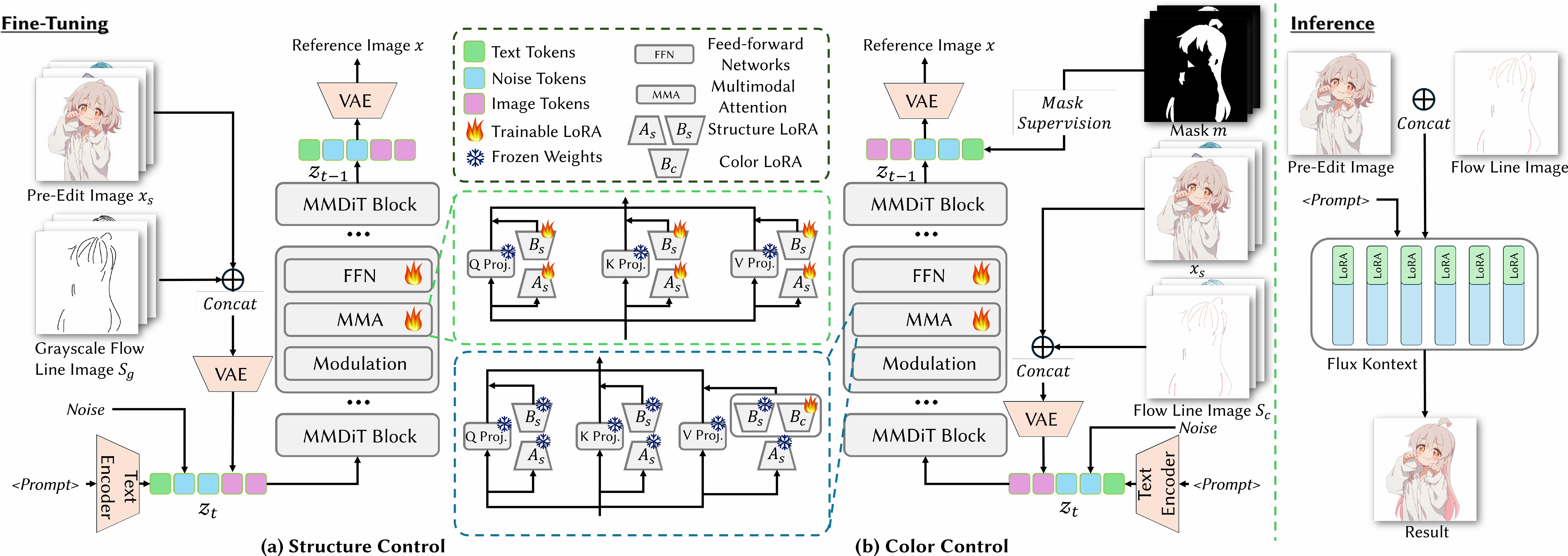
Framework of our method. Our framework then comprises two core components during fine-tuning: (a) Structure control, which regulates hair structure generation via LoRA injected into all layers; (b) Color control, which guides hair color generation through LoRA applied to specific layers together with mask-based supervision. During inference, we apply the fine-tuned LoRAs and produce the output using the pre-edit image and the flow line image.
Dataset
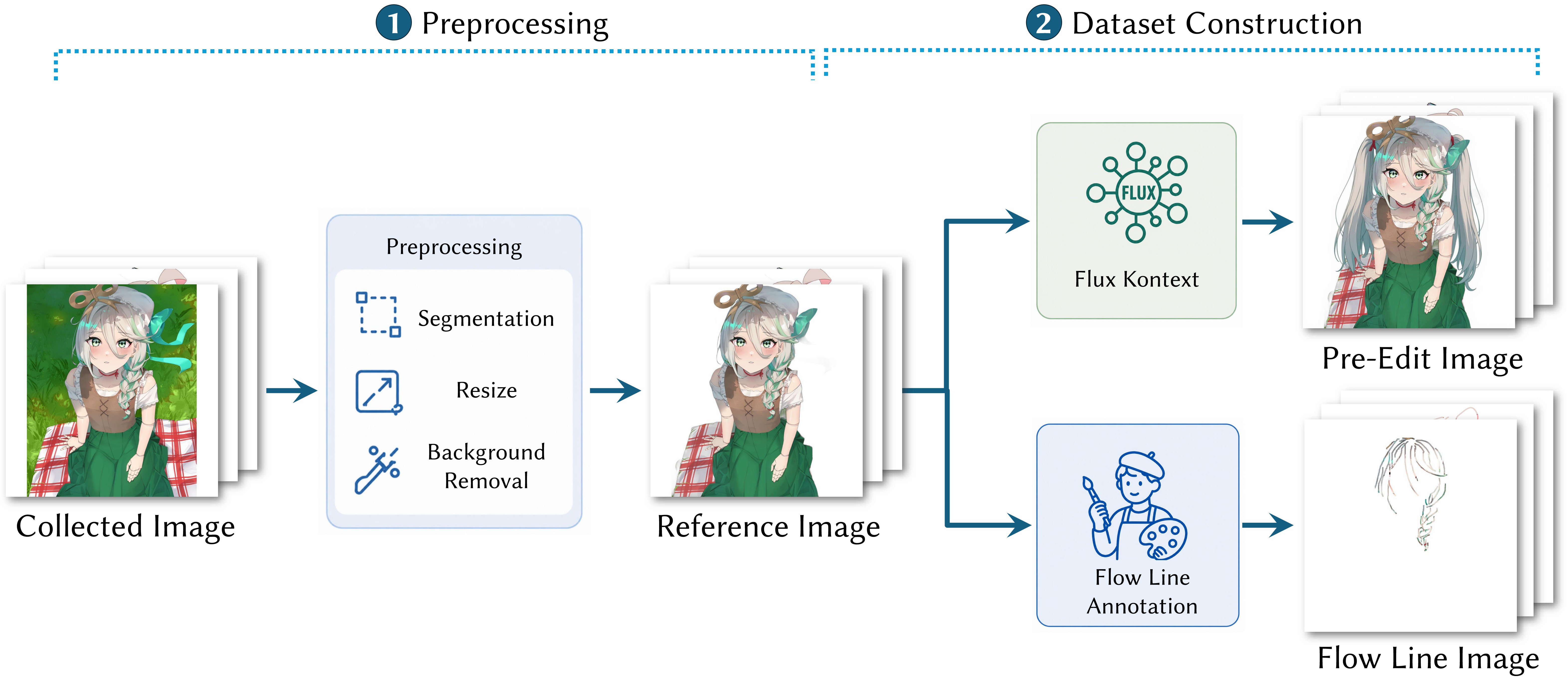
Dataset construction pipeline. Images collected from the website, we preprocess them to obtain reference images, from which we derive pre-edit images via FLUX Kontext and flow line images via manual annotation.
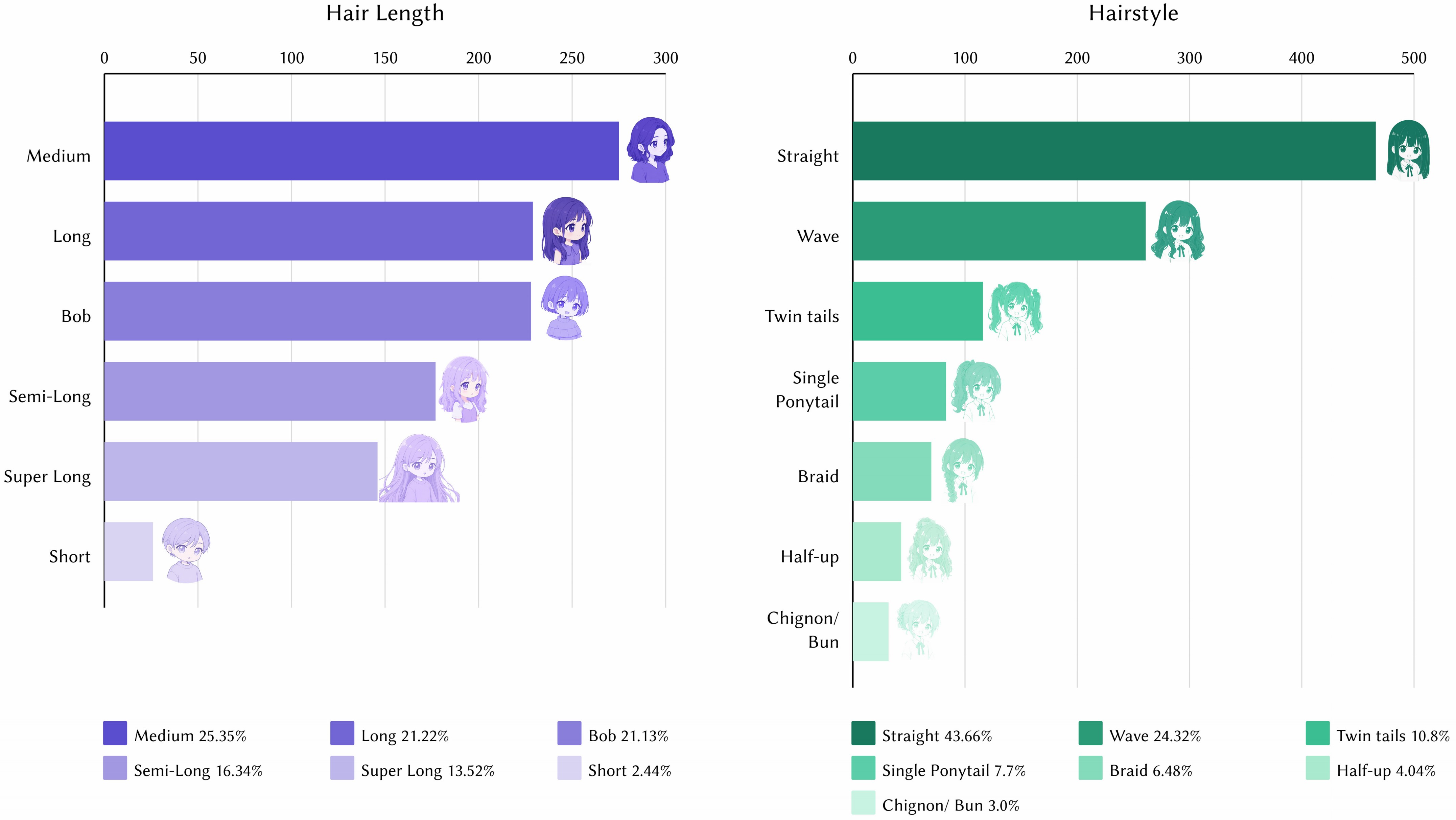
Hair dataset statistics. Distribution of hair length categories (left) and hairstyle types (right) across the dataset.
Results
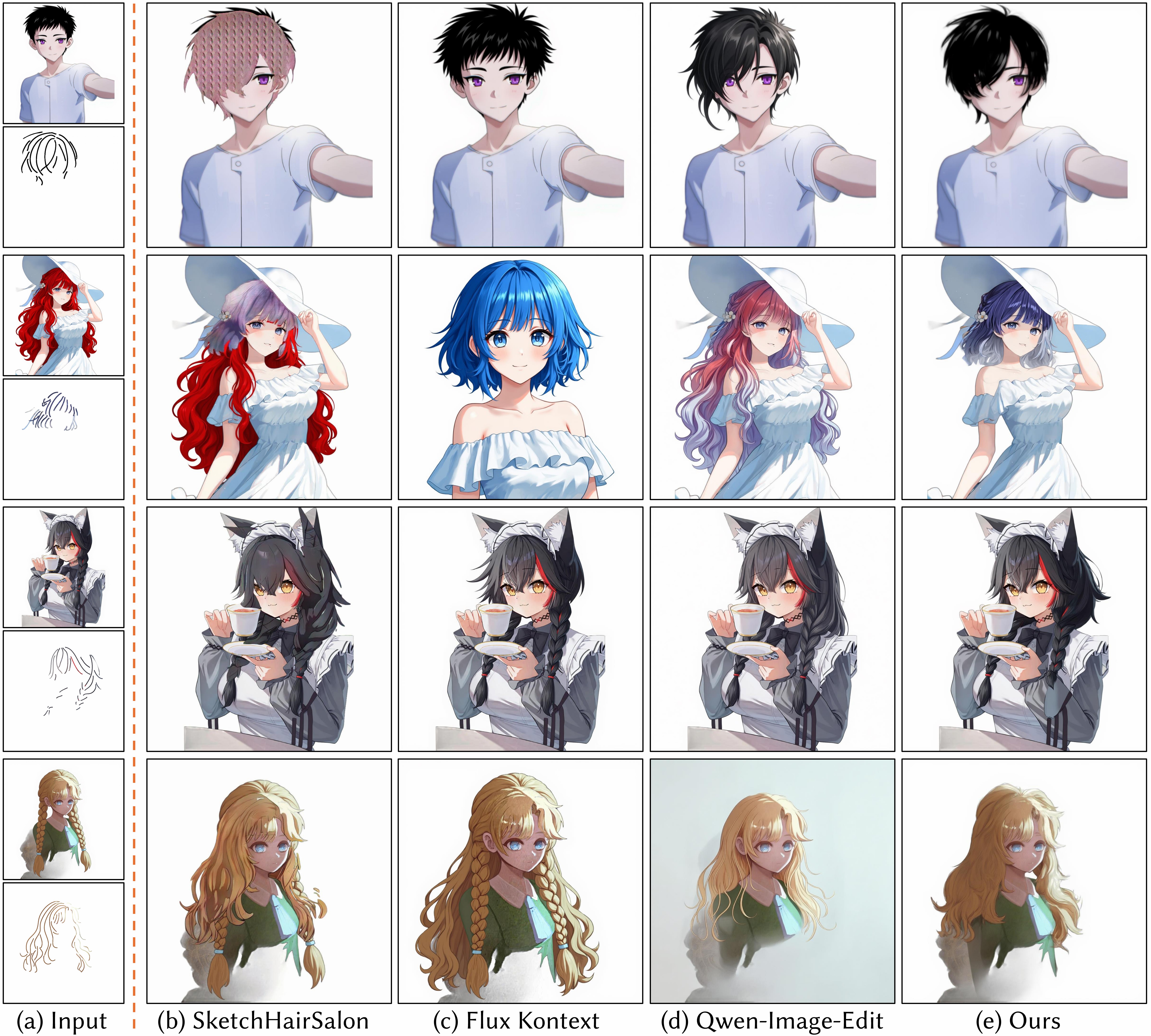
Comparison with existing methods using sketch input. Our method enables controllable editing of both hairstyle structure and color guided by the flow lines and preserves the character identity.
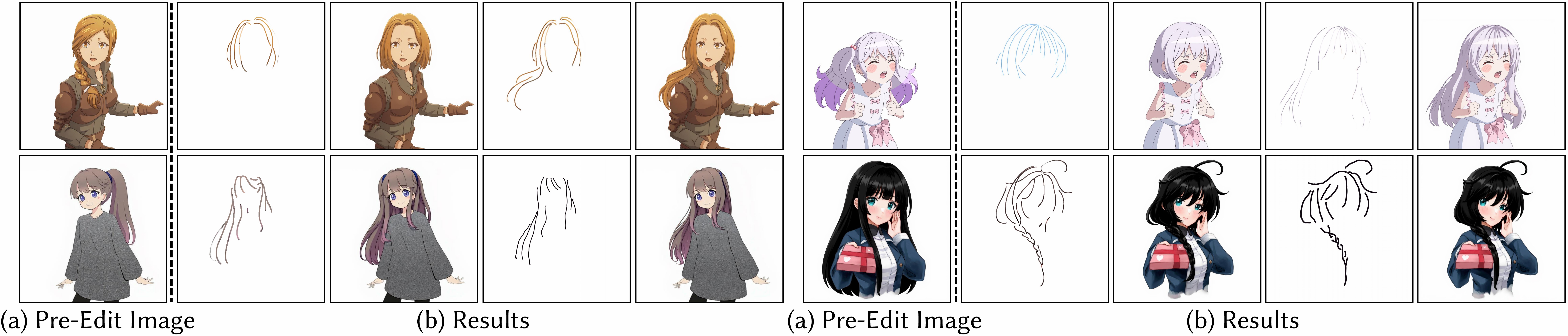
Top: We show new hairstyle designs for characters used in anime production, highlighting the diversity and generalization capabilities of our method.
Bottom: We show flow line images of varying quality describing the same hairstyle and their results, demonstrating robustness to input quality.
Copyright: © Junpei Inuzuka, IMAGICA INFOS / Restaurant to Another World 2; © IIS-P / “Ponnomichi” Production Committee.
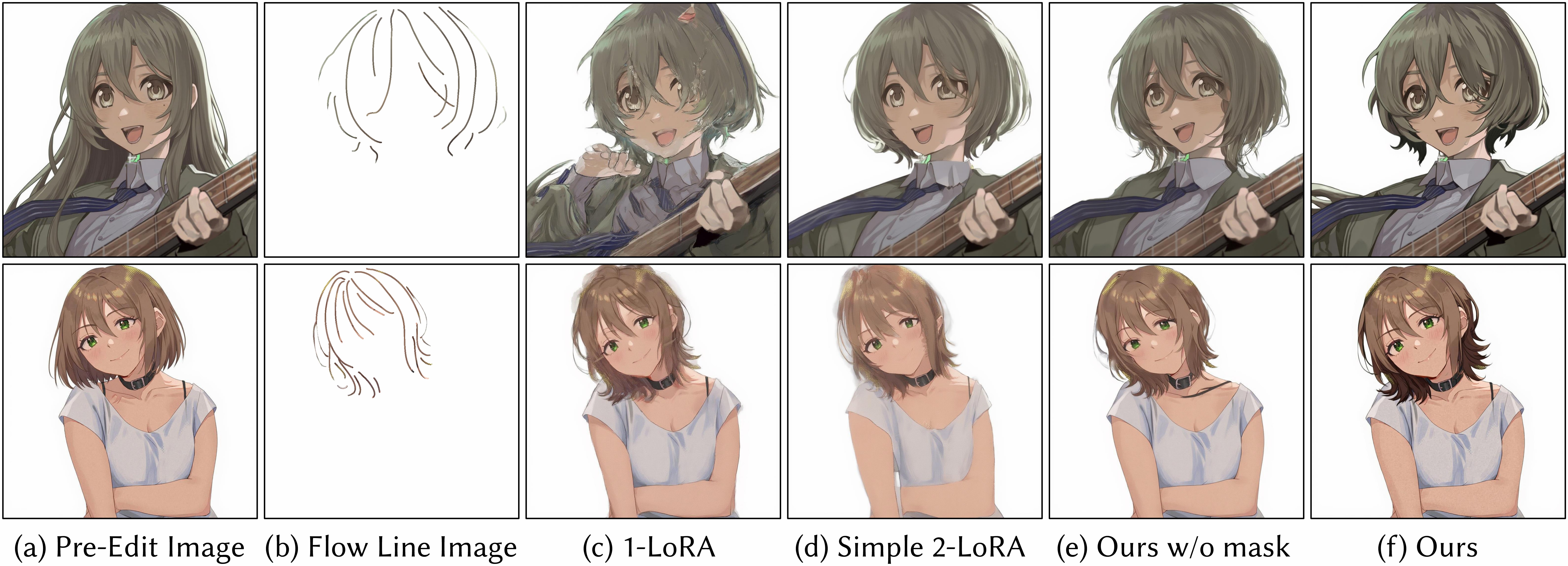
Ablation study. Given (a) the pre-edit image and (b) the flow line image, (c–e) show results of different ablated variants, while (f) shows the result of our full method.
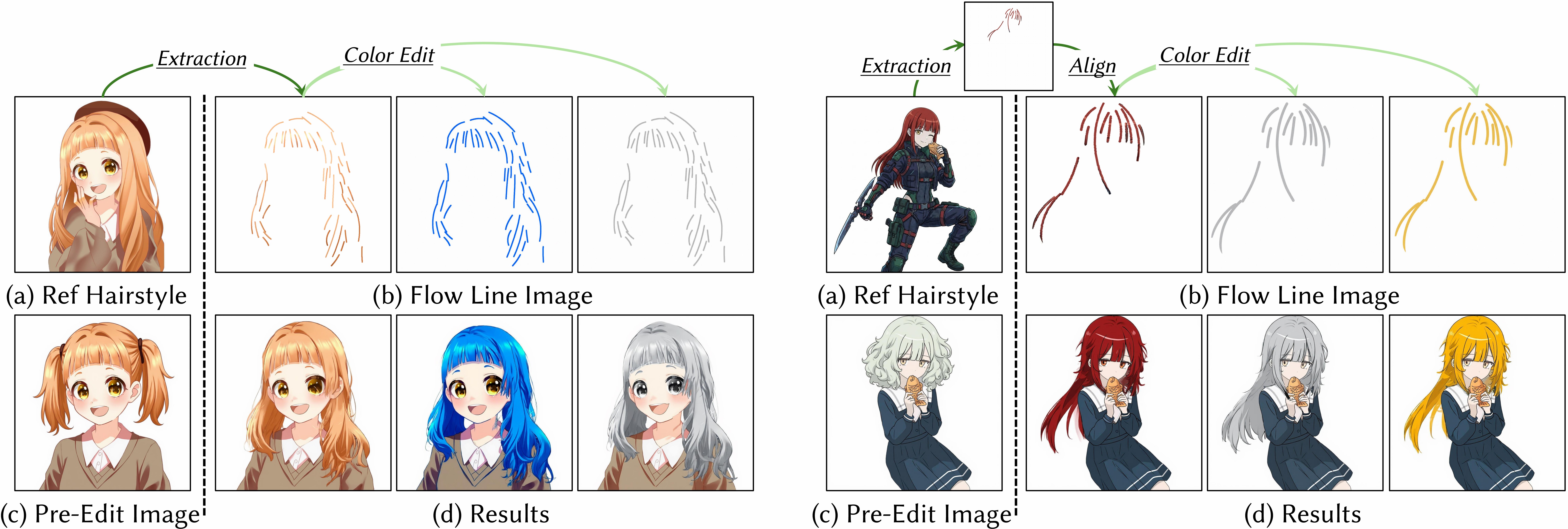
Hair transfer via aligned flow line guidance. Flow line image extracted from the (a) reference hairstyle is aligned to the (c) pre-edit image and used to guide synthesis. This enables hairstyle transfer at the structural level rather than pixel-wise copying. Furthermore, (c) and (d) show that the method produces consistent results under different color conditions, while preserving the underlying structure.
Hair editing via flow line manipulation. Flow line image extracted from the (a) pre-edit image is used as a structural representation of the hairstyle. By modifying the (b) flow line image, corresponding (c) hairstyle variations are generated. Structural changes in the flow line images are consistently reflected in the results (d).
BibTeX
@inproceedings{zhang2026structure,
  title={Structure--Color Disentangled Anime Hair Synthesis via Flow Line},
  author={Zhang, Tianyu and Shen, I-Chao and Xie, Haoran},
  booktitle={Proceedings of the SIGGRAPH Asia 2026 Conference Papers},
  pages={1--12},
  year={2026}
}